CQ WEEKLY – IN FOCUS
Sept. 29, 2012 – 12:41 p.m.
The Salton Sea: Will the Hill Spring for Saline Solution?
By Shawn Zeller, CQ Staff
When the stench began to waft over Imperial and Riverside counties and all the way northwest to Los Angeles on Sept. 10, calls from worried Californians flooded the offices of the Salton Sea Authority. The independent agency was created 19 years ago by California to manage the state’s largest lake, the 376-square-mile Salton Sea, which is slowly evaporating into the desert sky.
|
||
|
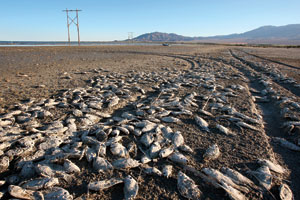
The fumes — hydrogen sulfide, the result of rotting fish and plants killed off by salinity levels that now exceed the Pacific Ocean’s by 37 percent — had been stirred up by strong winds. They were unpleasant but not harmful. Still, for
Bono Mack is furious that her state government has done little to fix the problems at the sea, and she wants Congress to intervene. She believes that the Salton Sea Authority has come up with a solution that will save the sea and won’t stress the exhausted treasuries in Washington and Sacramento. The Authority would cut the sea in half in order to save it and would pay for the project with renewable-energy production. All that’s needed, the Salton Sea Authority contends, is some initial funding and a commitment to make sure the necessary permits are granted.
Still, Bono Mack is not the first to see a solution to what is now a decades-old problem. Congress has repeatedly looked at the challenges posed by the sea’s evaporation. Because area rainfall is limited and the sea is cut off from the ocean and the Colorado River, agricultural runoff is its only source of inflow — and evaporation diminishes that every year. Congress enacted a law 14 years ago to study possible solutions, but it has since ceded control to California.
Government paralysis, at both the state and federal levels, is reminiscent of the policy response to so many slow-moving environmental disasters. Think climate change or over-fishing or Chesapeake Bay cleanup. When great expense is involved, it’s easier to ignore the problem than raise the money or impose the regulations necessary to fix it.
“We’ve had many alternatives and studied this for a substantial time,” says Andrew Schlange, the Salton Sea Authority’s interim general manager. “We need to get started. The problem is, all the governments are broke right now, or saying so.”
Cut in Half?
|
||
|
Bono Mack is trying to get the process moving again. Last month, she sent a barrage of letters to state and local officials, to Interior Secretary
Tim Krantz, a professor at California’s University of Redlands who studies the sea and backs the Authority’s plan, says the problem goes beyond his state. “It’s interstate and international,” he says. And he has a dire warning: Allowing the sea to continue to dry up would create “the worst particulate air pollution in the Western Hemisphere, if not in the world.”
The Authority’s plan would preserve the northern half of the lake and develop the southern lake bed — for geothermal and solar energy and for lithium mining — to pay the approximately $5 billion cost of the project. The energy development would have the added benefit of maintaining the newly exposed land rather than allowing it to turn into dust and then air pollution. Krantz believes the plan would not only pay for the preservation of the sea but also replace imports of lithium (used in high-end batteries) from China and Brazil, and also provide enough power for 8 million homes.
Such a drastic solution wouldn’t cut any geological corners, because the Salton Sea was an accident from the start. In 1905, an irrigation project to aid farmers in California’s Imperial Valley went awry: A diversion in the Colorado River failed, and water spilled into a depression; stanching the flow took a year and a half. The sea that resulted might have evaporated in the desert heat, but Congress in 1928 designated it a good spot for absorbing runoff from nearby farms. The Salton Sea now takes in about 900,000 acre-feet of water each year while another 1.4 million evaporate.
The Salton Sea: Will the Hill Spring for Saline Solution?
Long before the salinity levels began to kill fish and drive off vacationers, developers pitched the area as a resort spot for city-dwellers from the coast. But since its heyday in the 1950s, tourism has dried up along with the lake.
Bono Mack, who represents part of the lake and the district to the north, has prioritized its management since she took over the House seat held by her husband, the entertainer Sonny Bono, who died in a 1998 skiing accident. Later that same year, Bono Mack — she has since married Florida GOP Rep.
In 2000, Interior’s Bureau of Reclamation issued a report detailing the huge challenges ahead. In 2003, the California Legislature passed a law claiming control, and four years later the state’s environmental agency released its own plan, at $8.9 billion. The legislature never funded it, though, and the issue has since devolved into a fight between state lawmakers and the administration of Democratic Gov.
In 2007, Bono Mack teamed with California Sen.
“At the local level, there’s a sense of unity but also urgency,” she says. “We need that same commitment at the state and federal levels.” The federal government needs to play a role, she says, because it owns much of the land below the sea, but the Salton Sea Authority is best suited to take over for the state as the restoration project’s principal overseer.
Reducing the sea’s salinity and stabilizing its water levels is a huge engineering project. Plans to do so have been drawn up and scrapped; efforts are now essentially at a standstill. The state’s $8.9 billion plan calls for a dam and a network of canals and pumps; maintenance would cost $142 million annually. The Salton Sea Authority’s plan to cut the lake in half would cost about half as much.
But both plans require more study, and, because of budget pressure, Brown this year vetoed the state legislature’s plan for a $2 million report on the path forward.
No More Water
Bono Mack hopes the stench that wafted west for two days in September will spur some action. The fumes were so rank that an aide to Democratic Rep.
Further deterioration of the sea is likely. A 2003 settlement between California and surrounding states will soon reduce California’s supply of water from the Colorado River. As a result, in 2017 local authorities must stop the flow of agricultural runoff into the Salton Sea and divert the water for use in the cities to the west. The sea’s salinity level will then rise even more, killing off the lake’s last remaining major fish species — tilapia — and the sea will become a breeding ground for bird diseases.
The threat to wildlife is not new. What is, say those who are trying to preserve the sea, is the threat of air pollution from the dust. And they hope that message will now resonate in Washington. “I do think Mary’s right to give it one more shot,” Krantz says. “It’s not about fish and wildlife and all of the fantastic resources that the sea used to be about. It’s now about human health.”
FOR FURTHER READING: California water funding (PL 108-361), 2004 Almanac, p. 9-3.