CQ WEEKLY – COVER STORY
2012 ELECTIONS
Nov. 10, 2012 – 11:26 a.m.
Seizing a Compromise After the 2012 Elections
By Steven T. Dennis, CQ Staff
President Obama’s re-election presents him with at least a momentary chance to break a two-year standoff with Republicans in Congress and forge bipartisan compromises on major issues that proved impossible to reach during his first term.
|
||
|
Knowing the opportunity may be fleeting, Democrats hope to take full advantage of their position, beginning with negotiations aimed at averting the fiscal cliff at year’s end. Democrats view the election results as an endorsement of their positions on fiscal issues, preservation of the social safety net, immigration policy, health care and even abortion rights.
Republicans, while regrouping and confronting evidence that the electorate is not where they thought it was, will try to hold the line against tax rate increases and look for chances to advance portions of their own agenda.
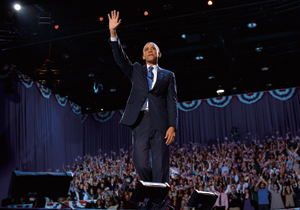
Obama sought to move past the bitter fights of the past two years in his victory speech in Chicago.
“Tonight, you voted for action, not politics as usual. You elected us to focus on your jobs, not ours,” he said. “In the coming weeks and months, I am looking forward to reaching out and working with leaders of both parties to meet the challenges we can only solve together — reducing our deficit, reforming our tax code, fixing our immigration system, freeing ourselves from foreign oil. We’ve got more work to do.”
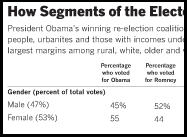
The election, however, showed the country to be as divided as ever — Obama won by only about 3 million votes out of 119 million cast — and his mandate is not as strong as it was four years ago when he made history as the first African-American elected president and brought with him large Democratic majorities in Congress.
But Obama’s political worries are over, and he has enormous leverage in his ongoing battle with the Republicans because their top priority — extension of the George W. Bush administration tax cuts set to expire Jan. 1 — will not happen unless the GOP strikes a bargain with him. Obama has vowed to veto any legislation that extends the current upper-bracket tax rates.
Democrats will return to Washington emboldened by the surprising expansion of their majority in the Senate, along with a handful of pickups in the House.
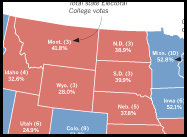
Obama’s comfortable victory in the Electoral College shocked the GOP, and his big margins among Hispanics, women and young voters forced Republican leaders to acknowledge their party’s shrinking base of older white men. They quickly declared their intention to change their approach, starting with immigration policy.
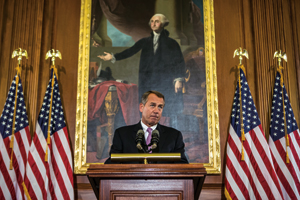
House Speaker
“Mr. President, this is your moment,” Boehner said, offering an olive branch. “We’re ready to be led, not as Democrats or Republicans, but as Americans. We want you to lead — not as a liberal or a conservative, but as the president of the United States of America. We want you to succeed.”
Boehner told reporters Nov. 9 he would be open to eliminating some tax breaks and deductions while reducing tax rates. A simpler tax code would also be more efficient and lead to more revenue, he suggested. And he expressed confidence that if he and the president can reach agreement, he can get the votes.
Seizing a Compromise After the 2012 Elections
“When the president and I have been able to come to an agreement, there’s been no problem in getting it passed here in the House,” Boehner said.
Obama said on Nov. 9 he will seek new economic stimulus measures and will insist on higher taxes for those making more than $250,000 a year when he begins talks with congressional leaders this week. The president said he was encouraged by Boehner’s offer of new tax revenue as part of a broad deficit reduction deal, but he rejected the Republican’s insistence that the election results were not a mandate for higher taxes on the wealthy.
“This was a central question of the election,” Obama said. “Our job now is to get a majority in Congress to reflect the will of the American people.”
The president said his immediate agenda includes providing businesses with incentives to create jobs, boosting clean energy, hiring veterans and rebuilding infrastructure.
Obama’s Leverage
|
||
|
Several factors now work in the Democrats’ favor.
About 90 percent of the $500 billion-a-year fiscal bomb set to go off a the end of 2012 — the tax increases and the defense portion of the spending cuts — targets Republican priorities. Democrats and the White House are ready to let current law take effect if the GOP insists on cutting back entitlement programs and doesn’t buckle on making upper-income taxpayers pay more.
“I think there is room for optimism,” said
How hard a bargain Obama demands and what he manages to achieve could set the tone for his second term. Either he will reach a deal with Boehner before the start of the year on a way to avoid the fiscal cliff, or his inauguration will take place in the midst of an epic fight over taxes that will damage the economy and set up a gridlock until the 2014 elections.
The Congressional Budget Office projected last week that the scheduled tax increases and spending cuts would reduce next year’s gross domestic product by 3 percentage points and send the economy into a recession with a loss of more than 3 million jobs.
The White House and Senate Majority Leader
Boehner and Senate Minority Leader
Seizing a Compromise After the 2012 Elections
Boehner’s immediate concern is preparing his conference to accept the compromises he will surely need to make in order to prevent the GOP from being blamed for driving the economy off the cliff. After a conference call with House Republicans the day after the election, Boehner made carefully scripted public remarks in which he offered the framework for a deal — increased revenue resulting from revising the tax code, lower tax rates and savings from entitlements.
That is essentially an updated version of the grand bargain Boehner and Obama tried and failed to consummate last year, and it appears to follow the same general idea pursued by the president’s fiscal commission headed by Erskine Bowles and Alan K. Simpson.
Democrats don’t think Boehner can sustain a battle to protect the wealthy from higher tax rates. “The Republicans have a very clear choice here,” Van Hollen said. “The question for them is whether they are going to drive over the tax fiscal cliff, telling the American people that nobody gets tax relief unless Mitt Romney gets a bonus tax break. In my view that’s politically unsustainable.”
But Republicans warn Democrats not to overplay the hand dealt them by voters.
“I would say to those Democrats that a strategy based on punishing working Americans, undermining our national security, and threatening our economy with another recession, not only won’t work, but is the exact kind of ‘my way or the highway’ tactics that the voters rejected when re-electing a divided government,” House Majority Leader
Republican congressional aides warn that if Obama pushes too hard, he could wreck any chance of bipartisan cooperation.
“We’ve got big issues on the table, including our struggling economy and debt crisis most prominently,” said Boehner spokesman Kevin Smith. “The only way the next two years will be productive is if both parties work together and find common ground.”
Boehner has potential hostages of his own. Domestic spending will also be on the chopping block if the automatic cuts take effect, and the government will need another debt limit increase early next year..
Still, there is optimism in the air.
Maryland Democratic Sen.
A Wider Agenda
|
||
|
Aware that Obama’s leverage will never be greater than it is now, the administration and Democrats don’t want to limit the agenda to spending and taxes. The White House has a long wish list, and a single, negotiated, must-pass legislative package may be the best or even the only way to pass pieces of Obama’s job-creation proposals and even parts of his energy strategy.
Seizing a Compromise After the 2012 Elections
A variety of interests would love to see a catchall package on which their priorities could catch a ride — whether it be transportation advocates making a long-shot bid to raise gas taxes or climate change advocates talking up an even more difficult effort to enact a carbon tax.
Obama has emphasized infrastructure spending, education, research, tax relief for the middle class and small businesses, aid to states to hire teachers and assistance for homeowners who need to refinance their mortgages.
Most of those proposals have been rejected or ignored by the GOP. Any new spending will be a tough pill for Boehner to swallow, as he already faces conservative angst over any compromise with Obama on taxes. The Speaker might be more interested in tax incentives, and some Democrats including Van Hollen want to extend the current payroll tax cut.
Democrats note that the Simpson-Bowles plan, as well as other bipartisan deficit- reduction proposals, have supported short-term economic stimulus efforts coupled with longer-term reforms.
Obama’s team and Hill Democrats realize that their leverage to advance their agenda will fade once the fiscal cliff crisis passes.
“I think the president probably understands that his power starts decreasing as each day goes by,” said Robert Borosage, co-director of the liberal Campaign for America’s Future.
“He’s got to be once more the growth and jobs president and not the balanced budget constriction president,” Borosage said. “He’s got to use the arbitrary, self-made fiscal showdown to lay out a big argument to the Congress and the public about what we need to do to get the economy moving. If he’s the austerity president and the economy slows, Democrats will get slaughtered in two years and his legacy will be in trouble.”
Like Boehner, Obama’s dealmaking ability is constrained by pressure from within his own party. The president could come under fire from the left if he signs on to a grand bargain that includes cuts in Social Security and/or an increase in the Medicare eligibility age — things he considered accepting last year.
Reid said last week Democrats are not interested in touching Social Security, and other Democrats, including Sen.
New Life For Immigration Bills
|
||
|
The Obama priority that appears most likely to have new life as a result of the elections is an overhaul of immigration policy. Hispanic voters turned their backs on Republicans on Election Day, and GOP leaders publicly lamented their poor standing with a fast-growing portion of the electorate.
Boehner told ABC last week that a comprehensive, bipartisan immigration overhaul will be a top priority next year. “This issue has been around far too long,” he said. “A comprehensive approach is long overdue, and I’m confident that the president, myself, others can find the common ground to take care of this issue once and for all.”
Seizing a Compromise After the 2012 Elections
Cantor also put immigration reform atop a retooled GOP agenda, pitching it in his letter to House Republicans as a boost for the economy because it would “help American-educated entrepreneurs start and build businesses here rather than abroad.”
Lining up Republican votes for any compromise on immigration policy may be difficult, given the volatile politics of the issue within GOP ranks. The last time an immigration bill reached the Senate floor, two years ago, Republicans successfully filibustered the DREAM Act, which would give a path to citizenship to young people who were brought to the United States illegally as children.
But GOP leaders are bowing to demographic reality. Conservative political voices and strategists, from Sean Hannity to Karl Rove to Grover Norquist, said Republicans need to figure out how to reach Hispanic voters.
According to exit polls, 65 percent of voters said they support providing a path to legal status for illegal immigrants.
Hispanic voters backed Obama by a 71-27 percent margin, according to exit polling, and Obama campaign officials said that increasing Hispanic turnout was key in many swing states, including Florida and Colorado.
“They watched a Republican Party . . . use them as a political football,” said Obama campaign manager Jim Messina in a conference call with reporters. Talking about “illegals” and with standard-bearer Romney vowing to veto the DREAM Act “makes it very, very hard to go get votes in November.”
Republicans also are preparing an overall shift in their agenda, after spending much of the 112th Congress pursuing fruitless efforts to repeal the 2010 health care law. Boehner called the expansion of health insurance coverage “the law of the land” in an ABC interview and acknowledged the GOP will not be able to repeal the law with Obama in office.
Cantor’s letter also nodded to the shift in approach. “Throughout the 113th Congress we will prioritize legislation that can become law and help us get millions of Americans get back to work,” Cantor said in his post-election letter to his troops.
Cantor’s to-do list included nuts-and-bolts legislation such as consolidation of job training programs, streamlining of regulations and increasing school choice.
But that doesn’t mean House Republicans will stay away from politically charged topics. Cantor said the GOP still has its eye on bills that may be politically difficult for Democrats to oppose. As an example, he cited the 1996 welfare law President Bill Clinton signed after vetoing an earlier version.
Cantor told the House majority he holds out hope for expanding work requirements in welfare programs, boosting domestic energy production and repealing the independent board created by the health care law to find Medicare savings.
Second Term Precedents
Recent history establishes precedents for bipartisan accomplishments in a president’s second term.
Seizing a Compromise After the 2012 Elections
As Rahm Emanuel, Chicago’s mayor and Obama’s former chief of staff, pointed out in a CNN interview Wednesday, Clinton — also working with a Republican House — cut the 1997 budget deal that helped lead to years of surpluses and signed into law legislation creating the State Children’s Health Insurance Program.
President Ronald Reagan signed a sweeping, bipartisan tax overhaul during his second term in 1986.
But George W. Bush, despite the fact that both the House and Senate were in Republican hands, burned political capital on his ill-fated Social Security proposal. And Bush’s effort to overhaul immigration foundered for lack of support from his own party.
However, Bush managed to get Reid and then-Speaker
There is at least a chance, said both Republicans and Democrats, that once the fiscal cliff is resolved, it could build confidence for action on other measures, from energy to run-of-the-mill reauthorization and appropriations bills — the kind of formerly bipartisan legislation that has became ensnared in the never-ending partisanship of Obama’s first term. “The fiscal cliff will set the tone,” Cardin said.
Reid urged Republicans to change their tactics from constant filibusters, while warning he intended to modify the rules to limit the use of the filibuster.
“It’s better to dance than to fight. It’s better to work together. Everything doesn’t have to be a fight,” Reid said.
Steven T. Dennis is a Roll Call staff writer.